Baselines

Baselines are industry average carbon impacts per product category. Tangible uses them to calculate how your selected products compare to typical performance.

Baseline data sources

ProductsSourceCoverage
Steel, insulation, gypsum, glass, wood, and most categoriesCLF Material Baselines (2023)Industry-wide EPD averages
US Ready Mix, ShotcreteNRMCA Regional Benchmarks (2022 v3.2)Location-specific
Canadian concreteCRMCA Provincial Industry Wide EPDs (2022)Regional, per 2023 CLF document

Percent reduction

Product level

Each product with a baseline gets a percent reduction value comparing the assigned EPD against the industry average for that category. Positive means lower carbon than average; negative means higher.

% Reduction = (Baseline − Product) / Baseline × 100

Project level

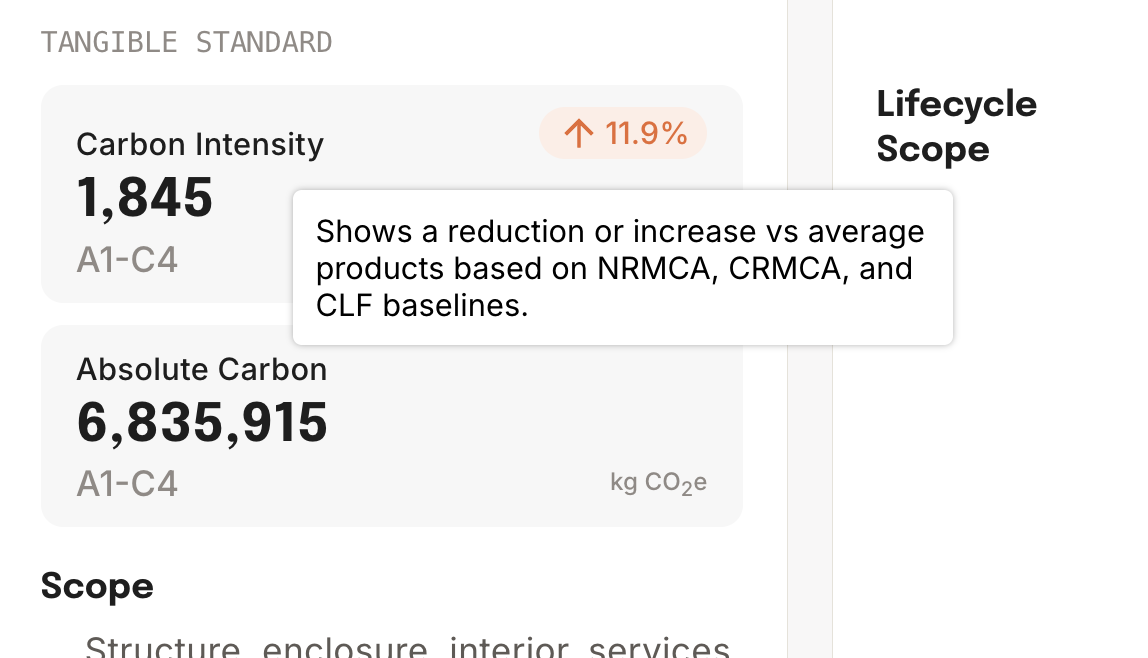
Tangible rolls up all product-level comparisons into a single project number — the percentage shown next to Carbon Intensity on your dashboard. This tells you how your project's overall carbon compares to industry average products.

Project dashboard showing 11.9% increase vs. average products based on NRMCA, CRMCA, and CLF baselines

Category notes

  • US Concrete — NRMCA baselines are location-specific. The Product page compares against the US national baseline; the Project view compares against the location-specific baseline.
  • Insulation — Board insulation % reduction includes A1–A3, B1, and C4 per CLF best practice (not just A1–A3).
  • Concrete Masonry Units — Aligned with GU cement block impacts.
  • Board Roof Insulation — CFG and GRF grouped under the more conservative CFG baseline.
  • Foamed-in-place and sprayed insulation — Baselines currently omitted; will be added as more data becomes available.
  • Categories without baselines — No % reduction chip is shown.

Was this page helpful?